
Romania, Barcelona, Japan
Romania
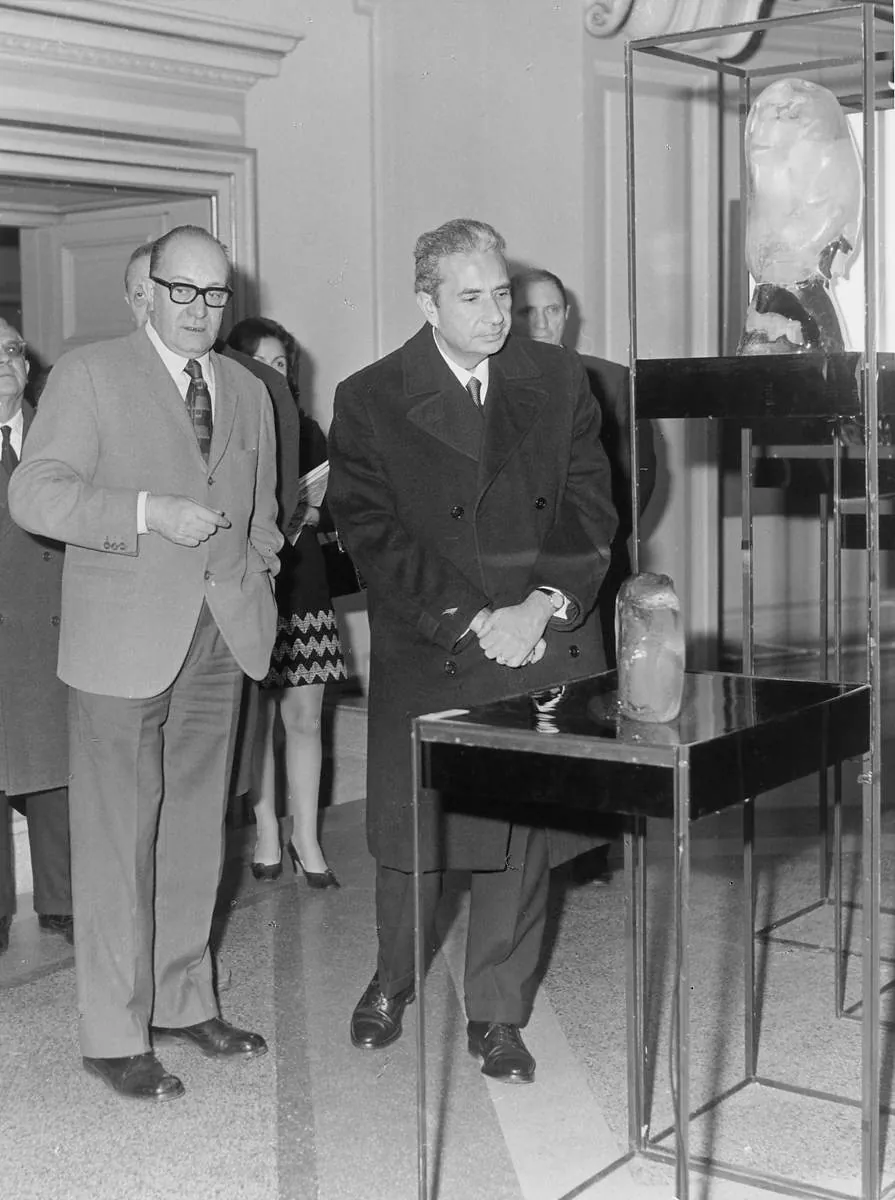
In 1970 the exhibition of the works of the Fucina in the Doge’s Palace in Venice draws the attention of the Romanian Ministry of Culture, which invites Egidio to exhibit in its country: Egidio accepts. Between 1971 and 1974 he goes to Romania several times, with his wife and his entourage, not only to show his works but also to teach the local craftsmen the modern techniques of working glass.
In those years the collaborations with Remo Bianco, Giuseppe Capogrossi and the Chilean Matta go on.
The Japanese artists
In the early 1970s the collaboration with contemporary Japanese artists grows, and in 1972 the Fucina shows their work in the Japanese Itineraries. From it come works such as the glass hands of Tadanori Yokoo or the forest of Takamichi Ito. With them Egidio tries out every “possible and imaginable” technique of the Art of Glass, in a search that will go on until his last years.
Proposal for a Cathedral
In July 1981 work begins on what will perhaps be his most significant work, the Proposal for a Cathedral. Misunderstandings and jealousies in the Murano world force him to leave the lagoon for the mainland. At Casale sul Sile, in the Vetrofond furnace, far from curiosity and controversy, assisted by the master glassmakers Dei Rossi, Tagliapietra, Ragazzi and Falcier, he works on the project: a door in glass, iron and wood, an altar in glass and crystal, a baptismal font in glass on a wooden base, and more.
The Proposal is first shown on 4 October 1981 in the Sala dei Notari of the Palazzo dei Priori, in Perugia: Egidio crowns a dream pursued for three years. Artists from all over the world have taken part in the work, among them John C. Portman, architect and engineer from Atlanta; Robert Scherer, painter and sculptor from South Tyrol; Reuven Rubin, Israeli artist; Mikuni Omura, Japanese architect and husband of Maddalena, the elder of Egidio’s two daughters; Amintore Fanfani, politician and artist.
Wine
In 1983, for Vinmondo, the wine fair that Friuli-Venezia Giulia holds in Pordenone, Egidio mounts an exhibition of the Fucina devoted entirely to wine, celebrated in all its facets: green and red bunches of grapes drawn by Robert Willson, a bottle whose stopper shows the drunken face of Mario Stefani, a soft hand caressing a bunch of grapes, by Mario Lupo, the blue Bacchus with golden glints by Picasso, the Bacchantes by Kokoschka.
Barcelona
In 1984 it is Spain that hosts the works of the Fucina: in Barcelona 109 pieces are shown, works already known and new ones, born of the collaboration with Giuseppe Agozzino, Mario Lupo, Luigi Tito, Giulio Turcato and Vanni Viviani.
On 3 May 1988, again in Barcelona, the Centro del Vetro opens the exhibition Woman, Universe, Harmony: works born of the imagination of some thirty artists, among them Herbert Pagani, guided and interpreted by Egidio. It is the occasion to present to the world the first glass Totems, each born of the meeting between Egidio’s imagination and that of the artists who work with him. Egidio dedicates the exhibition to Mamma Emi1, who died two years before: it is the way he chooses to express his love and his gratitude to his wife.
Notojima
In 1989 Egidio and the Fucina reach Japan: the works on show meet with such favour that the administration of the Kanazawa region2 buys 48 of them. They are still on show in the Notojima Glass Art Museum, built expressly to house ancient Chinese glass and Egidio’s new glass.
Sophia-Antipolis
That same year, at Sophia-Antipolis, near Antibes, on the Côte d’Azur, rises from his idea the Stamp of the Lake, a fountain in steel and glass of abstract forms.
Continued in the chapter The master of masters.